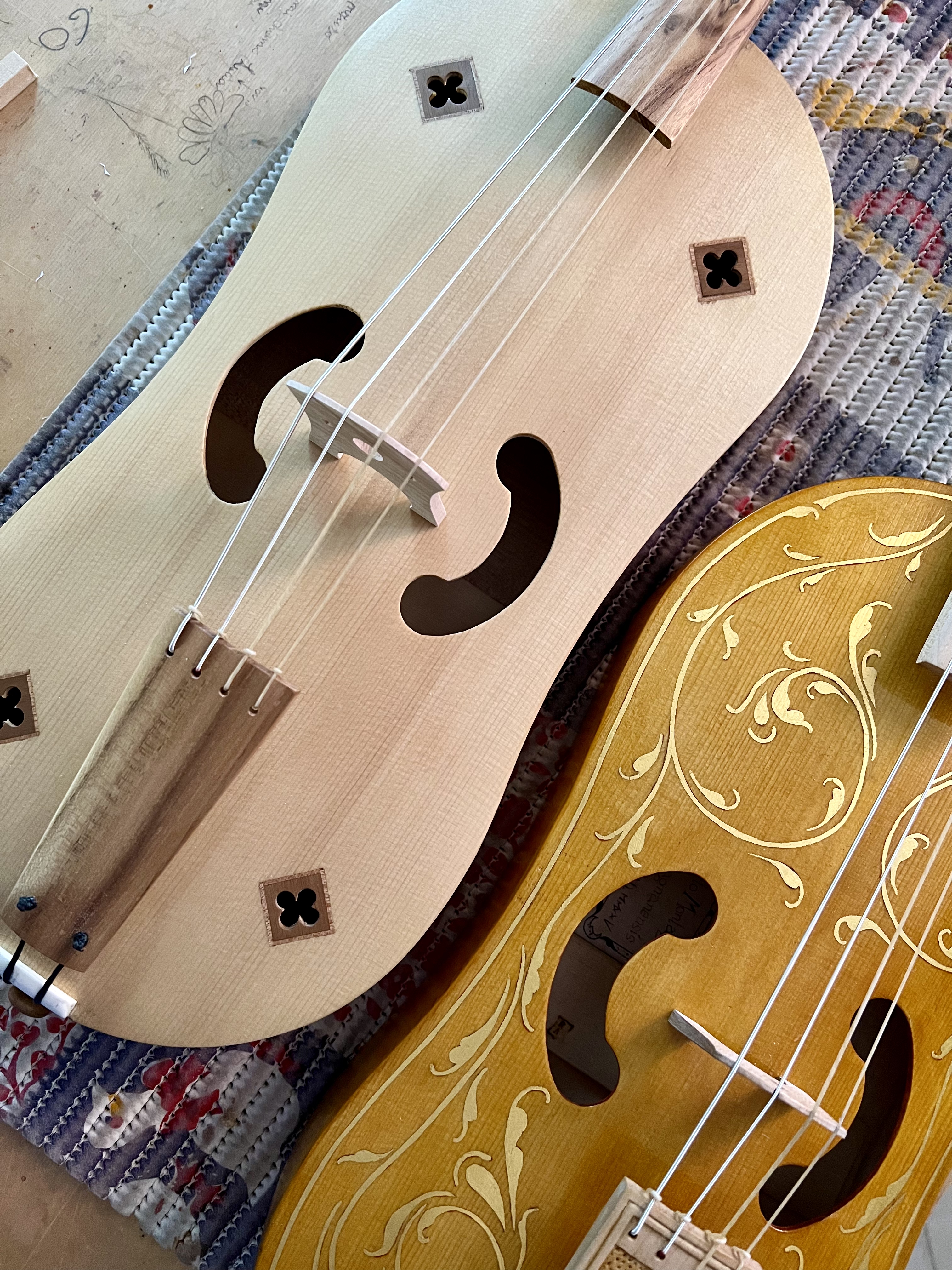
A medieval fresco can show an instrument with great precision and, at the same time, leave unanswered many of the questions necessary to build it. Reconstruction begins precisely from this distance between what the image shows and what the maker must decide.
The iconographic source as a starting point
I first observe the general form, dimensional relationships, the apparent number of strings, the position of the bridge, the profile of the neck, the pegbox and the way the musician holds the instrument.
One must also consider the nature of the image. A miniature, a monumental fresco and a sculpture follow different visual languages. Perspective may be conventional, some details may have symbolic value and others may have been simplified by the artist.
Measuring without pretending certainty
When the body of the musician or other comparable elements are present, it is possible to build hypotheses about proportions. I do not consider these relationships as absolute measurements. They define a plausible field within which the instrument can be developed.
Comparing sources
A reconstruction should not depend on a single isolated image. I compare the main source with instruments represented in the same period and cultural area, when available, and with knowledge of materials and working techniques.
Reconstruction and interpretation
I prefer to speak openly of interpretation. The iconographic source provides precious data, but it does not contain a hidden working plan to be decoded. Some decisions are supported by strong evidence; others remain reasoned hypotheses.